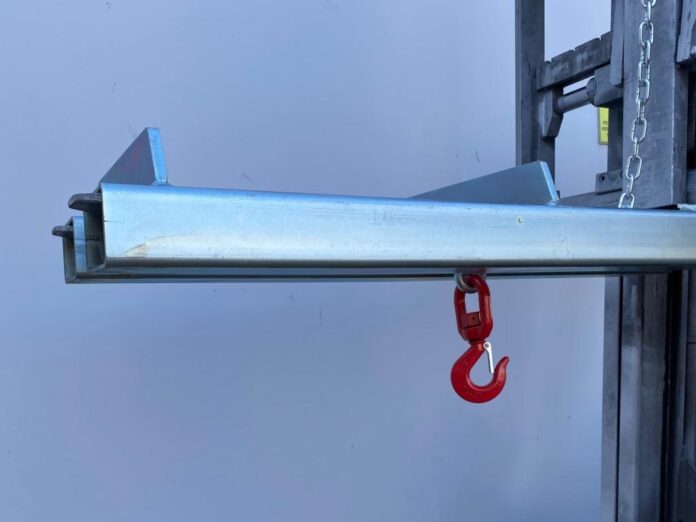

Standard forks are not tailored for every lift but forklifts were designed to transport loads efficiently and safely over distances. But you could have to do that differently while using slow, awkward, or by any means suspended loads.
A forklift with a standard mast can be attached to a jib attachment to allow it more lifting capacity. It provides an attachment point to lift loads that cannot be safely picked up with conventional fork.
What is a Forklift Lifting Jib?
Forklift jibs are an accessory used to lift loads in suspension with a hook or similar lifting point. Typically used in areas where work involves lifting, moving or positioning of materials short distance.
You mount this one on the front of your fork, and it goes beyond what most forks do. Several designs are available with fixed or adjustable lifting points for different applications.
1. Moving Steel and Metal Components
Long components such as steel beams, pipes, frames, etc., are usually manipulated in manufacture sites. Standard forks can prove difficult for positioning these loads.
Forklift lifting jib provides a more controlled lift point that can help operators position them with more precision on the right load.
In every situation, only carry loads low within the rated capacity of the forklift and jib! Before lifting, it should check the equipment combined specification.
2. Positioning Machinery
Many times, heavy machinery must be moved into an exact place during installation or repair.
They could also be used to give you reach and lifting ability when standard forks cannot get close to the load. This may prove useful when locating pumps, motors, machine components, and other compatible equipment.
Operators must plan the lift. Simulating a lift with an eye only on how it looks is one process through various steps.
3. Handling Pipes and Long Loads
Standard forks can make balancing long materials a hassle. Having a boy in place gives you can level that may quickly make some hundreds simpler to manipulate.
For sheathed pipes, beams, and structural components, construction sites could use jibs. The specific application varies based on the variant and load of the attachment.
Do not deem a jib safe for an unstable load. Correct rigging and load control of course remains a necessity.
4. Supporting Construction Installation Work
Some projects do not wait for the transport of material across the site. In general, they need to lift up materials into position.
An appropriate jib attachment is helpful for lifting equipment from the ground, putting structural components in place, or placing material where direct fork access may be difficult.
Prior to lifting, workers should inspect the work space for overhead hazards, as well as any other potential risks − e.g., people in the area.
5. Maintenance and Workshop Tasks
Jibs are helpful even in front of workshops and maintenance areas. They are useful in helping to lift appropriately-sized parts of equipment when repairing or replacement of machinery is necessary.
If you already have a forklift in your organisation, an attachment can be an economical solution for occasional hoisting without having to buy a crane for every application.
However, it should only be used for the applications for which it is designed and rated to be used.
Pick the Right Jib for Your Need
Not every jib fit for every forklift or lift application. When selecting an attachment, consider the reach and weight handling capacity, as well as the adjustability, and type of loads.
An appropriately matched jib can add flexibility to working without needing to pay for/gather another dedicated machine.
Get More from Your Forklift
A forklift lifting jib can be beneficial in construction, manufacturing, and maintenance environments. It enables the right forklift to carry out lifting operations which would otherwise mean different equipment.
A forklift lifting jib can be used properly to enhance versatility and workflow. But the number one priority is safe lifting first. Enables performance verification, promotes proper rigging and talks operators through how the attachment will influence forklift handling.